

From complex care to
meaningful progression.
The Social Care Programme Approach is a structured model for supporting people whose needs, risks or circumstances require a coordinated and responsive programme of care.
It brings together understanding, stabilisation, formulation, intervention, risk management and progression within one continually reviewed approach.
Discharge is not the same as progression.
For people leaving long-term hospital, secure or highly specialist care, discharge can represent an enormous achievement.
However, moving into the community should not be treated as the end of the journey.
Some people make successful transitions into stable community living, build relationships, develop independence and participate more fully in everyday life.
For others, progress can remain fragile. They may experience repeated placement breakdown, relapse, readmission, serious behavioural risk or high levels of restriction and supervision.
SCPA was developed around a simple principle:
Community placement should create the conditions for meaningful progression, not simply maintain stability.
Complexity does not disappear when someone leaves hospital.
The move from institutional to community-based care has created significant and positive change.
People are increasingly supported in ordinary homes, closer to relationships and communities that matter to them.
But deinstitutionalisation did not remove complexity. It changed where responsibility for that complexity sits.
Community providers may now support people with:
- Complex or recurrent mental health needs
- Trauma histories
- Learning disability or autism
- Communication or cognitive needs
- Significant behavioural risks
- Histories of forensic or institutional care
- Restrictive practice
- Multiple professional and organisational stakeholders
- Changing levels of risk and support need
Community services are increasingly expected to provide ordinary lives while managing extraordinary levels of complexity.
A care plan can describe support. It does not automatically create progression.
Care plans, risk assessments and Positive Behaviour Support plans are all important.
But when they operate as separate documents or are reviewed in isolation, they do not necessarily create a complete programme for change.
Care planning
May explain what support should be provided.
Risk assessment
May identify what could go wrong and how risks should be managed.
Positive Behaviour Support
May help teams understand behaviour and respond more effectively.
SCPA
Connects these elements into one structured, purposeful and continually reviewed programme.
The difference is between having a collection of plans and operating a programme capable of achieving meaningful outcomes.
Maintaining a placement vs developing a life.
Maintaining a placement
- Avoiding incidents
- Preventing readmission
- Managing immediate risks
- Maintaining routines
- Monitoring restrictions
- Responding when something goes wrong
Developing a life
- Building skills
- Strengthening relationships
- Increasing autonomy
- Supporting positive risk-taking
- Creating meaningful activity
- Reducing restriction through genuine progression
- Improving quality of life
- Measuring meaningful outcomes
SCPA shifts the emphasis from maintaining a placement to developing a life.
The programme must remain centred on the person's life.
Services can sometimes become focused on objectives that are measurable for the provider but do not necessarily reflect what matters most to the person.
Examples might include:
- Compliance with routines
- Greater tolerance of staff requests
- Attendance at scheduled activities
- Reduction in incident frequency
These measures may sometimes be useful, but they should not replace the person's own ambitions.
SCPA asks a different question:
What would meaningful progress look like in this person's life?
The answer may involve:
- Stronger relationships
- Greater independence
- Improved communication
- More meaningful activity
- Greater choice and control
- Better emotional regulation
- Increased community participation
- Reduced restrictions
- Improved quality of life
Reduction should follow progression, not replace it.
Reducing restrictive practice is an important goal, but simply removing a restriction does not necessarily create safer or more sustainable support.
If the underlying conditions have not changed, risk may increase and the restriction may eventually return.
- Restriction identified
- Pressure to remove
- Underlying conditions unchanged
- Risk increases
- Restriction returns
SCPA takes a different approach
It asks:
- Why is the restriction currently needed?
- What skills need to develop?
- What relationships need to strengthen?
- What environmental or systemic conditions need to change?
- What alternative strategies can be developed?
- What evidence would show that reduction is safe and sustainable?
Restrictive practice reduction should be a consequence of effective progression, not an isolated administrative exercise.
A live programme of understanding, action and review.
The Social Care Programme Approach brings the different elements of complex support together within one structured system.
Rather than treating care as a collection of separate tasks and plans, SCPA manages support as a purposeful programme that is continually reviewed and adapted.
It connects:
- Stabilisation
- Pattern identification
- Formulation
- Intervention
- Relational practice
- Behavioural understanding
- Safety planning
- Progression planning
- Restrictive practice governance
- Outcome review
The aim is to create a shared understanding of the person, consistent support across the team and a clear route towards meaningful outcomes.
Understand. Stabilise. Learn. Act. Review. Progress.
- 01
Stabilise
Establish immediate safety, consistency and a shared understanding of what helps the person feel secure and supported.
- 02
Identify patterns
Look for patterns across distress, behaviour, relationships, staff responses, routines and the wider environment.
- 03
Formulate
Bring the available information together into a shared understanding of what may be happening and what may be maintaining the difficulty.
- 04
Intervene
Develop purposeful strategies, interactions, skills and opportunities linked to the formulation.
- 05
Review outcomes
Examine what is changing, what is not changing and whether the programme is being implemented consistently.
- 06
Progress
Adapt support, increase opportunity and reduce unnecessary restriction as evidence of progress develops.
Review can return the programme to earlier stages when new information emerges. Understanding, action and progression remain continually connected.
Better questions lead to better support.
- What does stability mean for this person?
- What patterns are visible across distress, relationships, staff responses and the environment?
- What is our shared formulation?
- What might the person be communicating through their presentation?
- What is helping?
- What may be maintaining the difficulty?
- What does the person want their life to look like?
- What skills, relationships and opportunities need to develop?
- What restrictions are currently in place, and why?
- What conditions need to exist before restrictions can safely reduce?
- What evidence would demonstrate meaningful progress?
- Who is responsible for each action?
- When will the programme be reviewed?
- What will the team do if the expected change does not occur?
One programme. Connected practice.
Relational practice
How relationships, communication, staff responses and consistency influence safety, trust and engagement.
Sociotherapeutic practice
How everyday interactions, routines and the social environment can be used purposefully to support stability and development.
Behavioural understanding
Understanding distress, behaviour, regulation, escalation and what may be influencing presentation.
Safety and positive risk
Managing foreseeable risk while supporting autonomy, opportunity and the least restrictive response.
Progression
Developing meaningful goals, skills, relationships and opportunities connected to the person's own ambitions.
Governance and review
Using evidence, multidisciplinary working, review and accountability to ensure support remains purposeful and responsive.
Turning understanding into practical support.
SCPA is not simply a theoretical model. It can bring together practical tools and processes including:
- Baseline summaries
- One-page guidance
- Pattern maps
- Regulation profiles
- Escalation pathways
- Formulation summaries
- Interaction protocols
- My Safety Plan
- My Progress Plan
- Outcome reviews
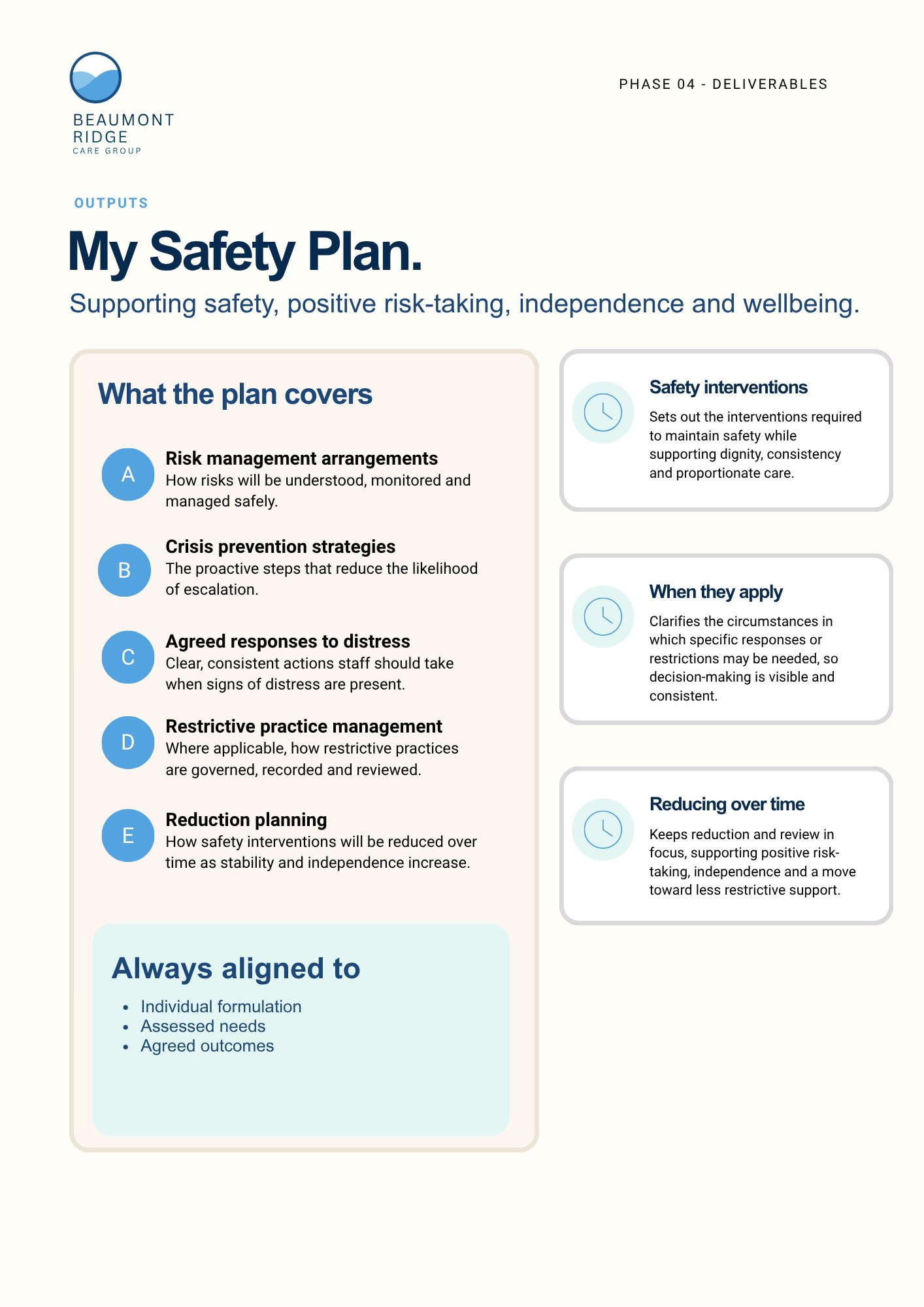
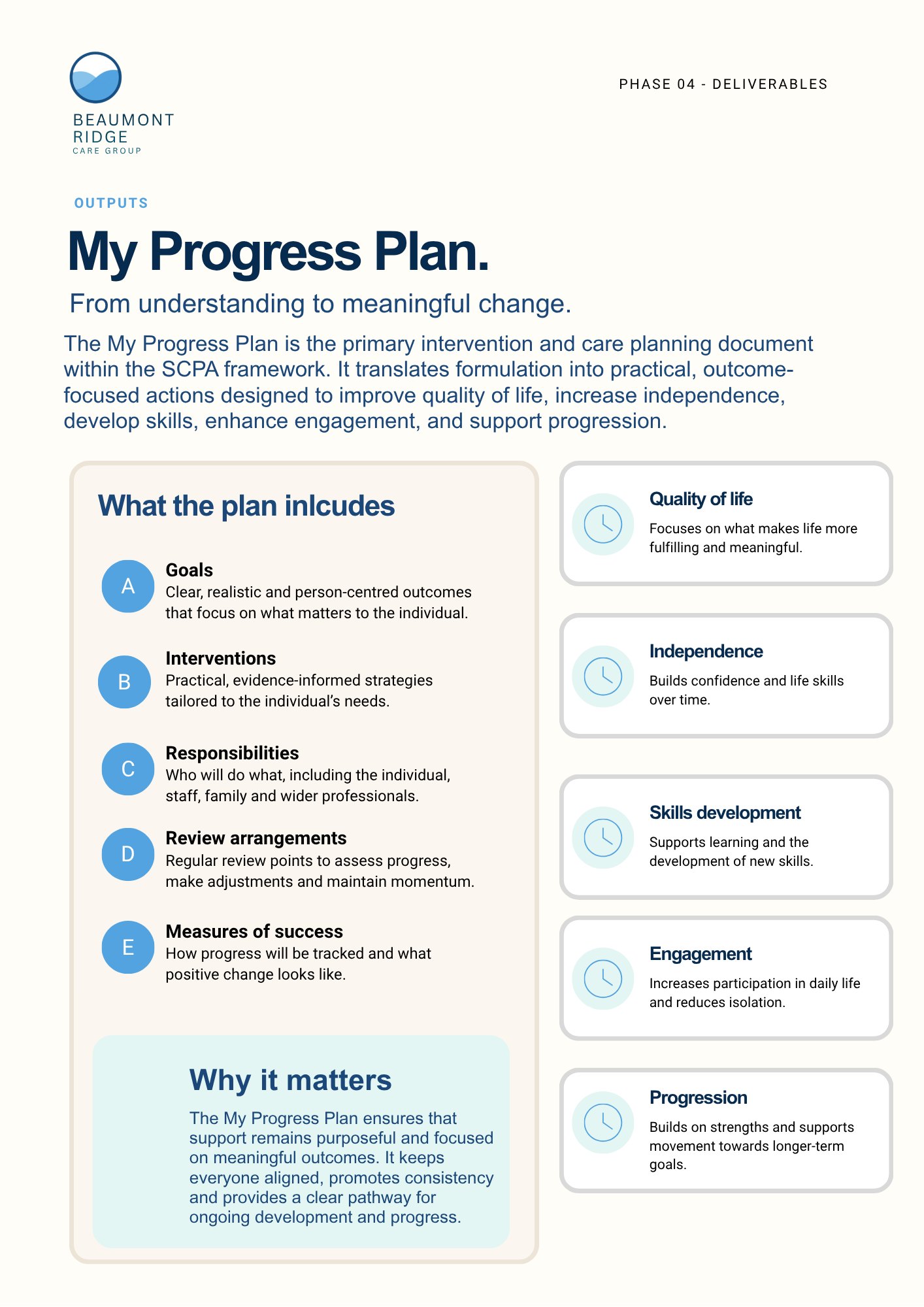
Examples of SCPA practice tools. My Safety Plan and My Progress Plan translate shared understanding into practical guidance for safety, development and meaningful progression.
The plans are designed to work together. My Safety Plan provides clear guidance around risk, distress, agreed responses and restrictive-practice reduction, while My Progress Plan connects support to the person's goals, skills, relationships, opportunities and measures of meaningful change.
For services supporting complexity, risk and progression.
SCPA is particularly relevant where support requires coordination across multiple areas of need and where ordinary care planning alone may not provide enough structure.
Potential settings and populations may include:
- Complex care
- Mental health
- Learning disability
- Autism
- Supported living
- Community-based support
- Forensic or post-secure pathways
- Services managing significant behavioural risk
- Services seeking to reduce restrictive practice
- Teams coordinating multidisciplinary support
SCPA is not required for every social care service.
A clearer framework for complex community care.
SCPA is designed to support a more connected approach. It can provide a framework for:
Greater consistency across staff teams
Clearer understanding of distress and behaviour
Better connection between assessment and intervention
More purposeful care planning
Stronger multidisciplinary coordination
More meaningful outcome measurement
Greater focus on the person's ambitions
More structured restrictive-practice reduction
Clearer responsibilities and review arrangements
Better evidence of progression
Outcomes depend on the person, setting and implementation. SCPA does not guarantee particular results.
From coordinated care to purposeful progression.
The Care Programme Approach established an important principle: people with complex mental health needs should not receive disconnected professional interventions.
It helped strengthen personalised care planning, coordination and accountability.
SCPA builds on that principle and carries it more deliberately into community social care.
Its focus is not simply on maintaining coordinated support after discharge, but on creating a structured programme through which stability, understanding, intervention and meaningful progression can be developed and reviewed.
SCPA does not replace statutory mental-health processes, formal clinical care coordination or professional judgement.
From understanding the principles to leading advanced practice.
The SCPA qualification suite provides a structured pathway for developing knowledge, practitioner competence, education capability and advanced practice.
Principles of the Social Care Programme Approach
Build foundational understanding of SCPA and how to contribute safely and consistently to an established programme.
Explore Level 2Social Care Programme Approach Practice
Develop practitioner knowledge and occupational competence across assessment, planning, implementation and review.
Explore Level 3 PracticeSCPA Education and Training
Develop the capability to plan, deliver, assess and evaluate approved SCPA learning.
Explore Level 3 EducationAdvanced Social Care Programme Approach Practice
Develop advanced capability in complex assessment, formulation, intervention, governance and practice leadership.
Explore Level 4The qualifications are currently in development. Register your interest on the relevant qualification page; availability and status will be confirmed.
View the SCPA qualification suiteExplore what SCPA could mean for your service.
Whether you are exploring SCPA for the first time, considering implementation across a service or developing workforce capability, Beaumont Ridge can help you understand the framework and the most appropriate next step.
Tell us about your service.
Tell us about your service and what you would like SCPA to support. A member of the Beaumont Ridge team will review your enquiry and contact you to discuss the most appropriate next step.
Fields marked * are required.
Thank you, we've got your enquiry
The Beaumont Ridge team will review your requirements and contact you to discuss delivery, availability and next steps.
If it's urgent, email enquiries@beaumontridge.care or call 07307 853143.